Being a Landlord in Singapore is not what its cracked up to be

It is a dream of many Singaporean to save up enough money, buy a second property and become a landlord with a constant income stream. When I had the chance to do so, I decided to do some calculations to see if it is worth it, just to be sure before making a big decision like this. All I can say is that it is not as good as investing in the stock market based on current average returns (which are not too different from historical trends). Assuming the we have $250k to invest in the stock market or down pay a property, the below table shows the calculations for both scenarios.
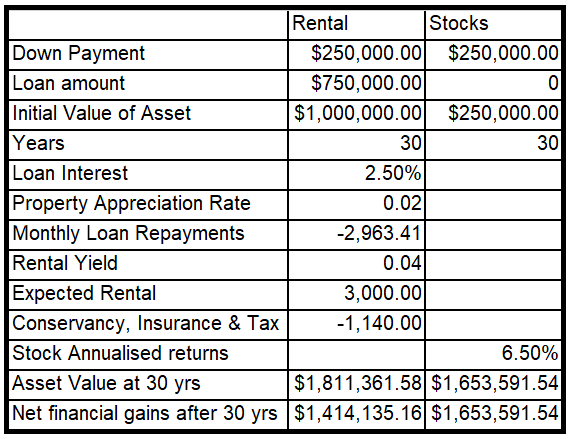
From this calculation and making the assumptions stated in the table, it shows that the net financial gains of putting $250k in the stock market is better than using $250k for down payment to buy a $1M property. Additionally, I have not included other hidden costs that the landlord will have to bear: repair costs, agent fees, lost of rent when between tenancies, sprucing up the place to maintain rental yield, decreasing value after 30 years when holding a 99 year leasehold property, etc. They all add up to make being a landlord even less attractive.

That said, I am aware that this is a generalised statement: this is only one calculation and not representative of all investments in property or stocks. And depending on the rental/stock yield that you get, and changing market forces, the numbers may change in favor of one or the other. I certainly cannot claim to have a crystal ball into the future, no one can. Also, depending on your investment portfolio, being a landlord may be a good way of diversification. At the end of the day, what is most important is acknowledging that one investment plan is not better than the other, and more people should be open to investing in the stock market. If you really want to invest in property, I would suggest buying Real Estate Investment Trusts (REIT) where you get to own a share of commercial, industrial, retail or hospitality properties.

P.S. This is also based on my experience being both a landlord as well as a renter. For the past few years, my wife and I decided to rent out our condo, and rent a condo at a better location for us (nearer work). And I must say, that being a renter is better. When air-con spoil, just call landlord’s agent. No need to pay MCST, car park lot also free. The only down side is that it is not your property, i.e. cannot paint the walls if you feel like it… so you better look for a place that you really like.

Now that we decided to sell our place, it was clear to me that it will be better to use the proceeds of selling my place to invest in the stock market instead of planning to get a second property. This is based on my own experience as a landlord, as an investor in the stock market, and, of course, the above projection calculations (I did a few variants with different assumptions which gave me confidence in my decision). Another advantage of the stock market is that it is much more liquid compared to property. In other words, its much easier to buy and sell company stocks than property.

Hope this is useful information for you too. Anyway, there are more calculations that I did. Will share more when I have the time to write it down.

A bit about stock market volatility and why the 4% rule can be misleading


There is this Financial Independence Retire Early (FIRE) message that is spreading and it is very attractive. Save a bit here and there, and I am on my way to a fully paid holiday for the rest of my life. The “FIRE” saying is that if you only withdraw 4% of your investment value as an annual income, you will be able to live off that perpetually. So, to have $2000 monthly income for the rest of my life, I will need $600,000.

Given that the minimum income to live in Singapore (assuming that your house is fully paid off) is S$1,379 a month (see this article), I assume $2k a month should be livable.

However, this 4% rule needs you to be invested in the stock market, and the stock market is very volatile. What this means is that your investment returns will not be the same as mine and there is a lot of uncertainty. Just take a look at the S&P 500 over the last 20 years (in the table below), it swings from -37% to +32% and everything in between. Using this data, we have a mean of 8.2% and standard deviation of 17.7%. This then begs some questions: With a $600k initial investment value, will withdrawing $24,000 (4%) per annum be wise given such large changes in the market? If I were to retire at 45 and live to 85, which means 40 years of retirement, will I be able to draw $2000 monthly or $24k annually with this $600,000 initial investment? Will this be able to weather a financial crisis? To answer this, I ran a Monte Carlo simulation with 100 runs. It is based on a 40 years retirement period, $600k initial investment value, $24k fixed annual draw down, and uses annual market returns with a mean of 8.2% and 17.7% standard deviation (as per the S&P 500 historical data from 1998 to 2018).

year returns
Dec. 31, 2018-4.38%
Dec. 31, 201721.83%
Dec. 31, 201611.96%
Dec. 31, 20151.38%
Dec. 31, 201413.69%
Dec. 31, 201332.39%
Dec. 31, 201216.00%
Dec. 31, 20112.11%
Dec. 31, 201015.06%
Dec. 31, 200926.46%
Dec. 31, 2008-37.00%
Dec. 31, 20075.49%
Dec. 31, 200615.79%
Dec. 31, 20054.91%
Dec. 31, 200410.88%
Dec. 31, 200328.68%
Dec. 31, 2002-22.10%
Dec. 31, 2001-11.89%
Dec. 31, 2000-9.10%
Dec. 31, 199921.04%
Dec. 31, 199828.58%

So, I crunched the numbers and the results are in… I found that in 15% runs, I would run out of money before 40 years are up. However, because the volatility is so high, in the very best case scenario (99th percentile), I got about $74,000,000 at the end of 40 years!!! Woahhhh……. At the 50th percentile (which will likely be the scenario), I would end up with with $3.5M in investment value at the end of 40 years, much more than the $600k initial investment. This is not surprising since my average investment returns are 8.2% which is double that of 4%. Nevertheless, this just goes to show how volatile the stock market can be and how it can affect your investments.

Another thing that I discovered was that the investments were not able to recover if i were to hit a bad patch and my investment values drops below $300k. It almost never recovers if I continue to withdraw $24k annually, even if i get some good years thereafter.

Perhaps I am getting it wrong, why would people recommend this 4% rule if it is so very risky. Maybe it will be better to withdraw 4% of the current investment value instead of a fixed value based on the initial investment? Time to re-run the Monte Carlo simulation with this change. 100 runs, again.

And, here are the results. With a draw down that is limited to 4% of the investment value, I will never run out of money since I will always have 96% of the value left. But in this case, I found that I will end up with less than the initial value of $600k, 18% of the time. The 50th percentile case ended up with an end value of $1.8M, and the best case scenario ended up with $19M remaining. Do note that for this simulation runs, as your investment value increases, so will your draw down value and at $1.8M, you will be able to withdraw $6k a month. As you can see, this is much more stable (with limited upside and downside), but it would mean that the draw down is market dependent. In all likelihood, your investment portfolio will likely continue to grow beyond your initial investments even as you draw 4% of it as income. But, when the economy dives, be prepared to go out there and do some free lance work to supplement your income. In the worst case simulation run I got, the lowest investment value was only $60k, one tenth of the initial value and it would mean a draw down of just $200 a month that year… So yes, there are pros and cons, but this is a much better and more sensible investment strategy than a fixed withdrawal amount. Anyway, shouldn’t you increase your withdrawal/income when your investment portfolio increases?

At the end of the day, when it comes to investing, we need to be flexible and allow for some volatility in the markets. This is an investment after all, not an insurance scheme. No pain, no gain.

I hope you like this little simulation analysis, it certainly was fun and insightful for me. Definitely good to do your own if you can, so that you can play around with the numbers to suit your investment goals better. By changing the numbers, you will also be able to quickly simulate various scenarios and see the risk/returns for yourself. I believe the insights gained and experience will be a good life lesson too.

Cheers!


S$1,379 monthly to meet basic needs

This is the amount that a recent study done by the National University of Singapore’s Lee Kuan Yew School of Public Policy found to be necessary for basic retirement after 65 years old. S$1,379 a month for a single elderly and S$2,351 a month for a couple.

While I suspect that the study was done to help government policy in meeting the needs of our graying population, this is useful for us as well. It will form a basis of what we need for retirement.

Statistically speaking, in Singapore, males would be able to lead healthy lives till 73 and live till 79, while females will have healthy lives till 78 and live till 84. If we retire at 60, that will mean that we have 13-18 years of good health to enjoy our golden years before our health deteriorates. The news article is here.

Let’s say that we want a bit more than S$1,379 and desire a S$3,000 per month payout from when we are 60 to say 90, how much do I need? With a 4% annual rate of returns on our investments, we need $634,000. That is not a small amount. But with the right planning, it is achievable. And it is easier the earlier we start.

On the other hand, if we plan to retire at 65, Singaporean can rely on the CPF Life annuity plan. More information is on the CPF Life website. As you can see, it is not too bad and achievable. At this point, we must remind ourselves to think long term and with just a little foresight and planning, we can achieve a peace of mind. Just in case you are not familiar with what is a life annuity plan, it is an insurance plan which turns your savings into a monthly payout for the rest of your life. So the longer you live, the more you get paid. It is basically a guaranteed income for life, like a pension. To me, this is a peace of mind that is worth every cent since you need not worry about an income or your savings running out. I cannot think of anything worse than to run out of money and living a miserable life, where each day is spend worrying about the next day.

Of course, if you are like me and want to achieve financial independence earlier (so that we are not dependent on holding to a job), a bit more thought will be needed. Baby steps along the way.